
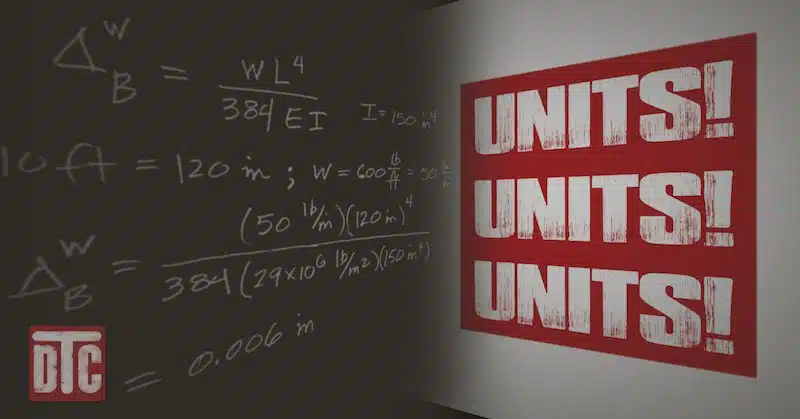
If I wasn’t Dr. Tom, I’d be Dr. Units. I cannot tell you how many times units are the reason someone gets the wrong answer to a problem. It might be as simple as inches needed to be converted to feet, or the other way around. Or, it is a combination of units like gallons per minute converted to cubic feet per second, and something doesn’t cancel. As I say as often as I can, if the units are not right it doesn’t matter what the number is. There are NO trivial units errors.
At every step in your solution, not just at the end, you should keep track of units. If you have a figure and there are dimensions given in both inches and feet, then a big FLAG should go up in your mind. Somewhere in your solution your will need to change the inches to feet or feet to inches. And the conversion is 12 inches = 1 foot. A factor 12. So the beam you are designing is going to be 12 times too big or 12 times too small. People, like your boss, are going to notice.
For those preparing for the PE Exam, take small steps in your solutions, using as many pads and pens as you need. Don’t do multiple steps in your calculator as there is no way to check if you don’t get one of the answers. Your calculator will do exactly what you tell it to do, but it may not be what you needed it to do. And if it is a predictable error associated with units, then there is a very high probably that the NCEES will make that incorrect answer, answer A, and you now have one less point in your column.
There is one thing you typically do not have to worry about relative to units on the exam, and that is converting between systems, like converting meters to feet or the other way around. About the only time I have seen this required is when horsepower must be converted to kilowatts.
Again, before even thinking about picking up your calculator, make sure the final units are such that they match the units in the exam answers. Then just be careful making the calculation. This is not the time to make a trivial mistake because you are in a hurry. Remember, you always have time to work the problems you know how to work. – Dr. Tom