Watch our video!
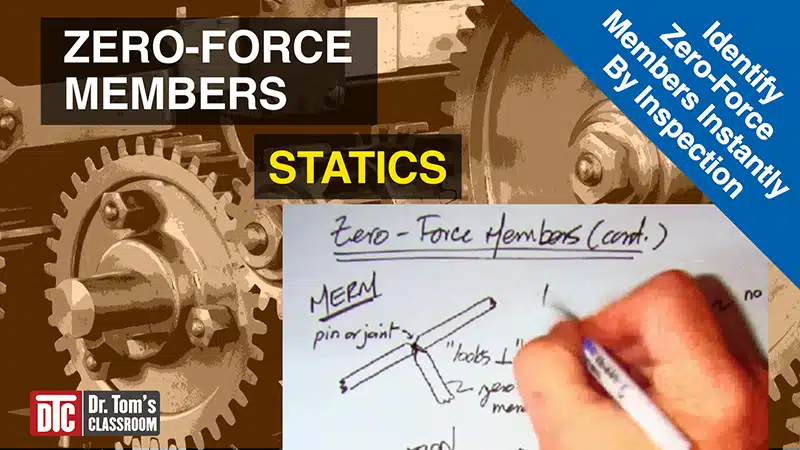
Zero-force members are associated with idealized trusses where all the members of the truss are two-force members. This means the members are connected only by pins, only loaded at these pin connections, and are in either tension or compression.
However, some of the members of the truss may have zero force acting on them, though typically these members cannot be removed as they are required for stability.
While any zero-force members will show up during the analysis of the truss, many times these members can be identified before the analysis by inspection. The presentation describes essentially four connections where one or two of the members are obviously zero-force members.
The two most common arrangements involve three members connected such that two of the members are colinear and the third is either perpendicular (Type 1) to the two colinear members or at some angle (Type 2). If there is no load at this connection, then the member at an angle must be a zero-force member. If four members are connected such that two members are colinear and two members are at some angle, then if one of those members is a two force member based on another connection, then the other member at this connection is also a zero-force member (Type 3). Also, there is a less common connection of just two members with no load at the connection, such that both members are zero-force members.
While identifying zero-force members before doing an analysis could be extra work, if the analysis did show that a member to be a zero-force member, the information in this presentation should help establish why it is a zero-force member.
-Tom
Mechanical PE Exam Prep That Works
Pay Up Front and Save $100!
Test Drive Your Course for Only $50!
Pay-As-You-Go and Start for Only $50!
Don’t miss out on the latest posts (and more)! Follow DTC on: